Archive: Žiga Vaupot's Blog

Clear filter — back to home
My presentations @ HROUG 2026

My presentations @ HROUG 2026

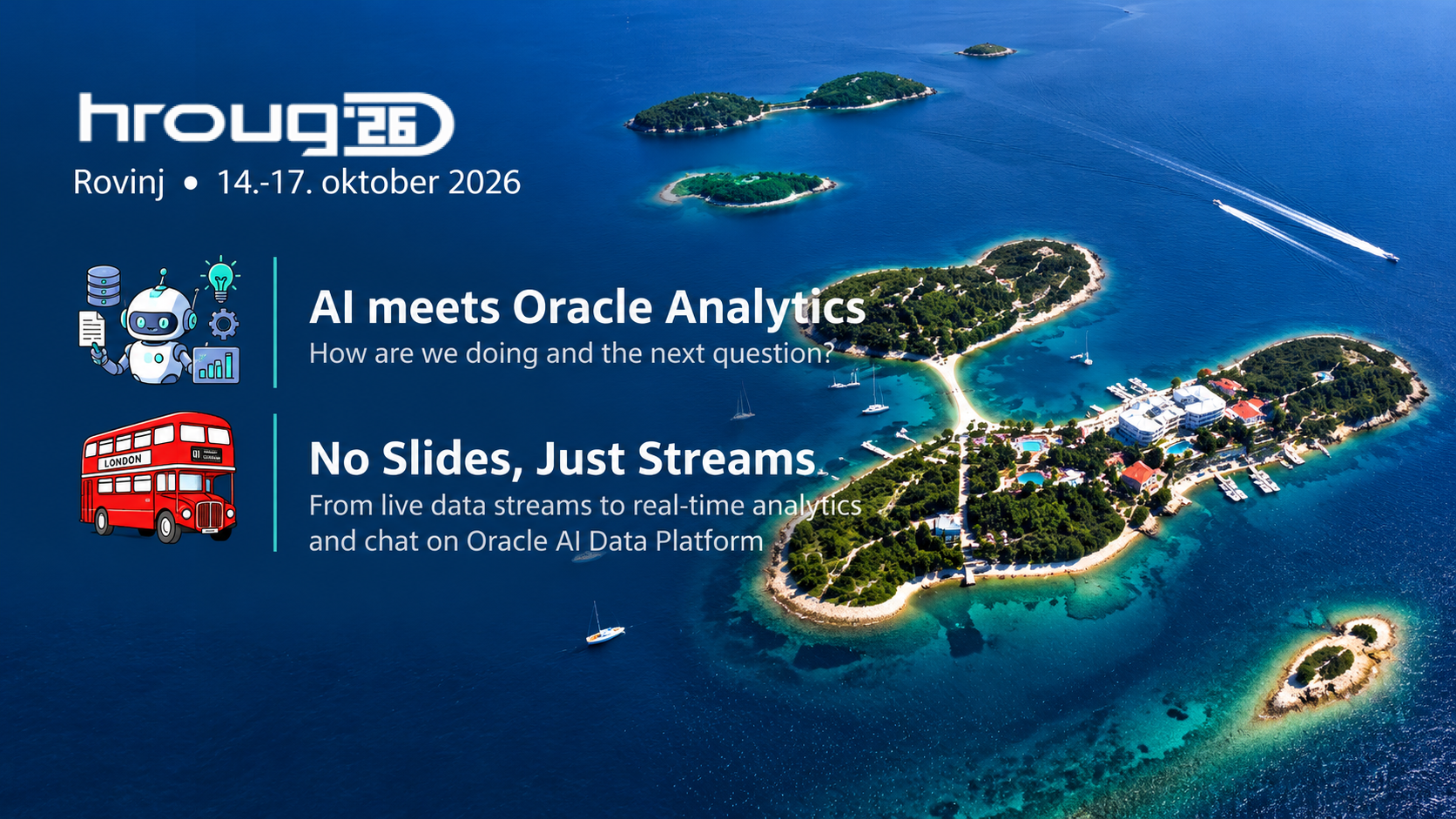
HROUG 2026, Rovinj, 14 to 17 October 2026: AI meets Oracle Analytics, How are we doing and the next question? and No Slides, Just Streams, From live data streams to real-time analytics and chat on Oracle AI Data Platform

This week I was in Rovinj at the HROUG 2026 conference, where I delivered two sessions. On 15 October I presented AI meets Oracle Analytics: How are we doing and the next question?, and on 16 October No Slides, Just Streams: From live data streams to real-time analytics and chat on Oracle AI Data Platform.

In this post I summarise what each session was about. Both slide decks are available for download at the end.

Read more
My presentation @ Autumn MakeIT 2026

My presentation @ Autumn MakeIT 2026

No slides, just agents: building an AI agent with Oracle Private Agent Factory, MakeIT, Ljubljana, 13 October 2026

On 13 October 2026 I presented at the MakeIT conference in Ljubljana. The session was called No slides, just agents (in Slovenian: Sestavimo agenta AI z Oracle Private Agent Factory), and the title was meant literally: a few slides to set the scene, then live agents built and run in Oracle Private Agent Factory (OPAF).

In this post I summarise what I showed: what OPAF is, where to get it, and five demos, from the pre-built Knowledge Agent through Select AI RAG and six Select AI Agent scenarios to the OAS MCP server. The slides are available for download at the end.

Read more
Using Claude Desktop with OAS MCP

Using Claude Desktop with OAS MCP

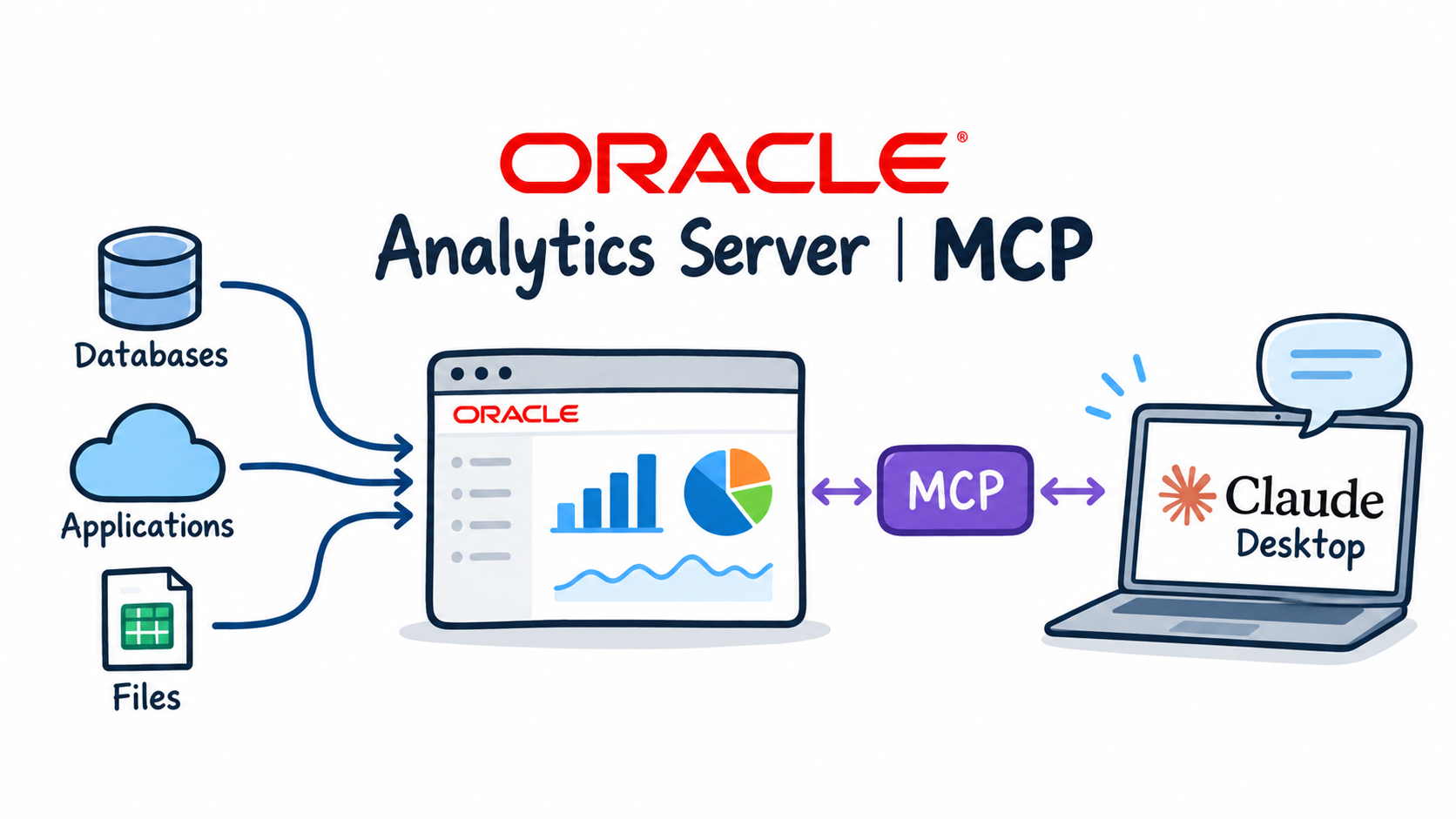
Claude Desktop querying Oracle Analytics Server through the OAS MCP server

In the previous post an OPAF agent queried Oracle Analytics Server through my MCP server. MCP is an open protocol, so the same server works with any MCP client, without changing a line of code on oas001.

In this post I connect Claude Desktop on my Mac to the OAS MCP server through an SSH tunnel and ask it the same questions as the OPAF agent. Then I go further: charts, a follow-up drill-down, and a short comparison of the two clients.

Read more
Using the OAS MCP server in OPAF

Using the OAS MCP server in OPAF

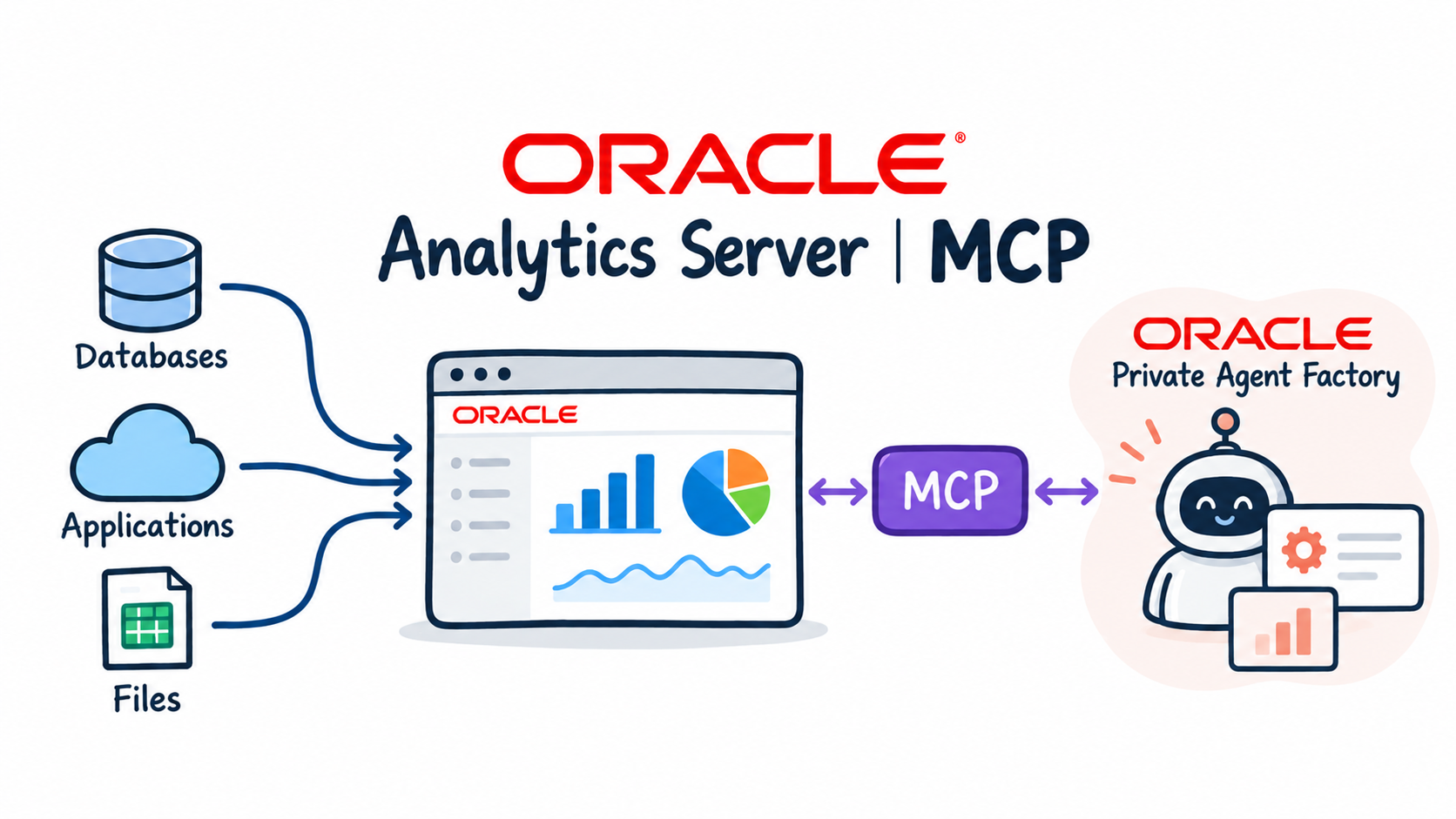
OPAF agent querying Oracle Analytics Server through the OAS MCP server

In the previous post I built the OAS MCP server and opened port 8000 for the OPAF subnet. Now OPAF becomes the MCP client.

In this post I change two OPAF proxy settings, register the server with a Bearer token and build a Custom Flow with an MCP server node and an Agent node. Then I test the agent with business questions and check in the service log which Logical SQL it sent to OAS. I close with what I would change before using the server with a customer's OAS.

Read more
Setting up the OAS MCP server

Setting up the OAS MCP server

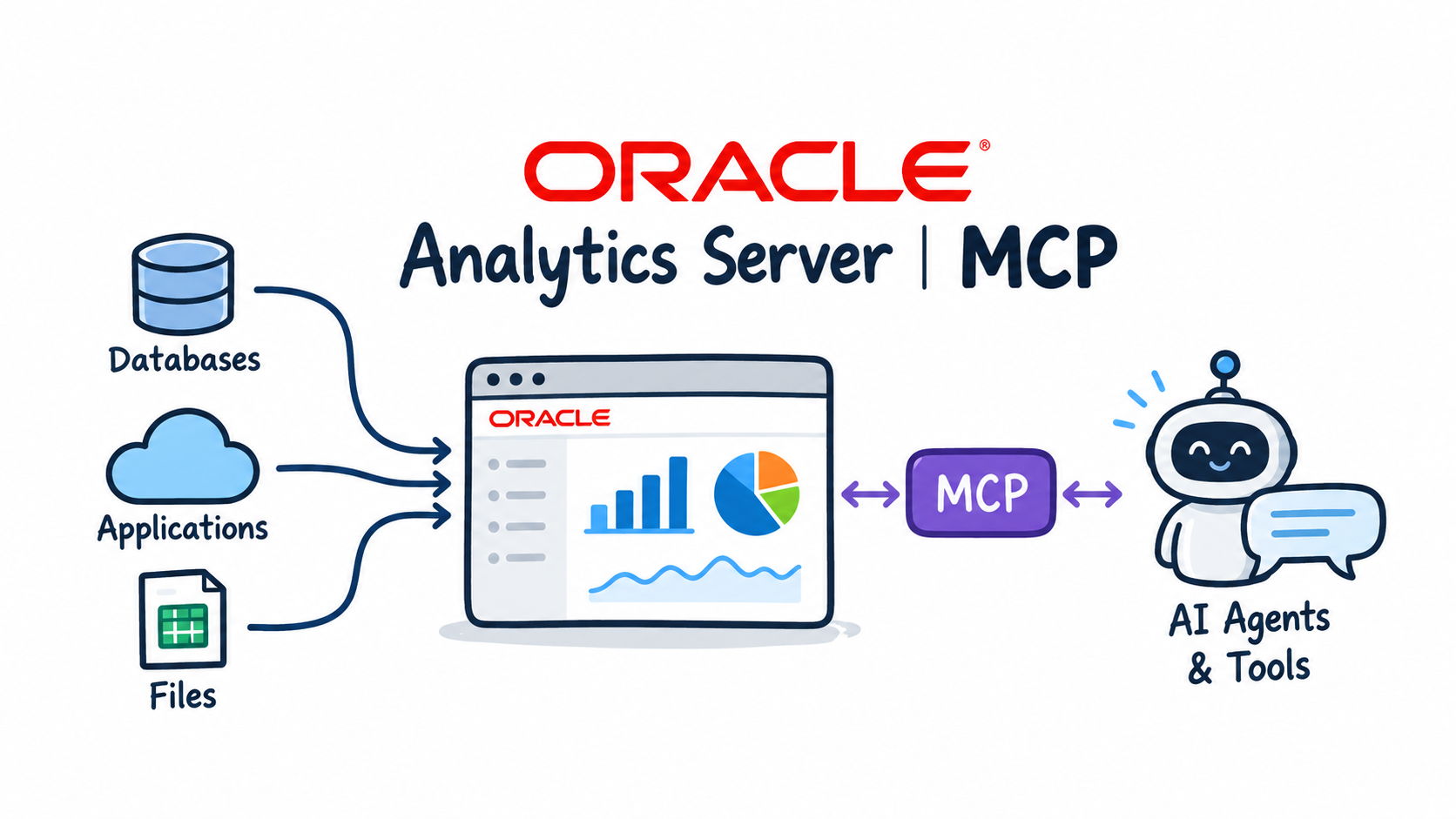
Oracle Analytics Server MCP & Use cases: OPAF agent querying Oracle Analytics Server through a custom MCP server

In the introduction I described the architecture and the four tools the server exposes. In this post I build it.

I walk through the Python code that talks to the OAS SOAP web services and wraps them as MCP tools, install the server on oas001 as a systemd service, test it with curl and open port 8000 for the OPAF subnet only. At the end the server answers tools/list with four tools, ready for an MCP client. The next post connects OPAF to it.

Read more
Oracle Analytics Server MCP & Use cases

Oracle Analytics Server MCP & Use cases

Oracle Analytics Server MCP & Use cases: OPAF agent querying Oracle Analytics Server through a custom MCP server

Oracle Analytics Cloud has an MCP server built in. Oracle Analytics Server does not. Many customers run OAS on premises or on their own compute, and their semantic models hold years of curated business logic that AI agents should be able to use instead of rebuilding it from raw tables.

In three short posts I build a small MCP server for OAS in Python, run it as a service next to OAS on an OCI compute instance and connect AI agents to it, starting with Oracle Private Agent Factory (OPAF). The server exposes four read-only tools on top of the OAS SOAP web services, which have been part of the product since OBIEE.

Read more
Chapter 8: Routing with Select AI Bridge

Chapter 8: Routing with Select AI Bridge

Select AI Agent meets OPAF

Chapter 4 showed two extremes: plain Select AI is fast but answers with one SQL statement, while the in-database team plans the analysis but takes longer. Chapter 7 put an OPAF agent in front of database tools over MCP. In this last chapter I combine the two ideas without MCP.

The Select AI Bridge node wraps a Select AI profile and action, or an in-database team, as a tool for an OPAF Agent node. It is the native alternative to MCP tools. With two bridges, one OPAF agent routes each question to the right database capability: simple lookups to fast single-query NL2SQL, analytical questions to the in-database agent team.

Read more
Chapter 7: OPAF Agents over MCP

Chapter 7: OPAF Agents over MCP

Select AI Agent meets OPAF

In Chapter 6 I enabled the Autonomous Database built-in MCP server and exposed the in-database agent team as a tool. Now OPAF becomes the MCP client.

In this chapter I register the ADB MCP server in OPAF and build two Custom Flows on it, each allowed exactly one tool, so it is always clear which architecture produced the answer. In Flow B the database orchestrates: OPAF hands the whole question to the Select AI Agent team. In Flow A OPAF orchestrates: its own agent plans the analysis and calls NL2SQL in the database. Both get the test questions from Chapter 4.

Read more
Chapter 6: The ADB Built-in MCP Server

Chapter 6: The ADB Built-in MCP Server

Select AI Agent meets OPAF

So far OPAF has reached the database through its native Select AI nodes. Those only exist in OPAF. To make the same in-database agent available to any MCP client, Autonomous AI Database has an MCP server built in: there is no MCP infrastructure to host, and it exposes the Select AI Agent tools the authenticated database user can access.

In this chapter I enable the MCP server on my ADW with a single tag, test it from the terminal with a bearer token and curl, and wrap the agent team from Chapter 3 as a tool, because MCP exposes tools, not teams. Chapter 7 connects OPAF to this endpoint.

Read more
Chapter 5: No-code Select AI Agent

Chapter 5: No-code Select AI Agent

Select AI Agent meets OPAF

In Chapter 3 I built the in-database sales analyst with DBMS_CLOUD_AI_AGENT in PL/SQL, and in Chapter 4 OPAF ran it with the In-Database Team node. The Select AI nodes can do more than run existing objects: in Create new mode they create them.

In this chapter I build the whole tool → task → agent → team stack visually on the OPAF canvas, starting from nothing but the Select AI profile OABOOTCAMP_AI and the table comments. The result, flow C3, answers the test questions from Chapter 4 exactly like the PL/SQL-built team.

Read more
Chapter 4: Native Select AI Nodes in OPAF

Chapter 4: Native Select AI Nodes in OPAF

Select AI Agent meets OPAF

With the Select AI profile from Chapter 2 and the agent team from Chapter 3 in the database, the simplest way to put them in front of users is OPAF's own Select AI nodes. They talk to the database over a database connection, with no MCP server, no wrapper functions and no LLM in OPAF.

In this chapter I build two minimal OPAF Custom Flows: C1 runs plain Select AI with the Select AI node, and C2 runs the in-database team with the In-Database Team node. Both get the same three test questions, which I reuse for every flow in the following chapters.

Read more
Chapter 3: A Select AI Agent Team in PL/SQL

Chapter 3: A Select AI Agent Team in PL/SQL

Select AI Agent meets OPAF

A single SELECT AI call answers one question with one SQL statement. Ask it to compare profit between two years by channel and pick the winner, and it has no step in which to plan that. Select AI Agent adds exactly that step: an agent can break a question into tool calls, run them and combine the results, all inside the database.

In this chapter I build an in-database sales analyst with DBMS_CLOUD_AI_AGENT on top of the Select AI profile from Chapter 2: one SQL tool, one agent, one task and one team. I run it, check its numbers against hand-written SQL, and show what made its answers repeatable. This team is the one OPAF calls in the following chapters.

Read more
Chapter 2: Connecting ADB to OCI Generative AI

Chapter 2: Connecting ADB to OCI Generative AI

Select AI Agent meets OPAF

With the schema prepared in Chapter 1, the next step is giving Select AI an LLM to work with. In my setup the database calls OCI Generative AI with its own resource principal, so no API keys are stored anywhere in the database.

In this chapter I check that the database version and the model support what I need, set up the IAM dynamic group and policy, enable the resource principal and network access, create the Select AI profile that every later flow uses, and run a few smoke tests to confirm that the comments from Chapter 1 actually shape the generated SQL.

Read more
Chapter 1: Preparing the Schema for Select AI

Chapter 1: Preparing the Schema for Select AI

Select AI Agent meets OPAF

Select AI turns a question into SQL, but it only knows what the data dictionary tells it. My OA Bootcamp schema (OABOOTCAMP) is a classic sales star schema with no declared keys and no comments, so out of the box Select AI has nothing to go on except column names.

In this first chapter I prepare the schema: I validate the join keys, collect the literal values the LLM must use, define the business rules, and write table and column comments that act as the semantic layer. Every flow in the later chapters (native OPAF nodes, MCP or routing) reads these comments, which is why they all return the same numbers.

Read more
Using Select AI Agents in Oracle Private Agent Factory

Using Select AI Agents in Oracle Private Agent Factory

Select AI Agent meets OPAF

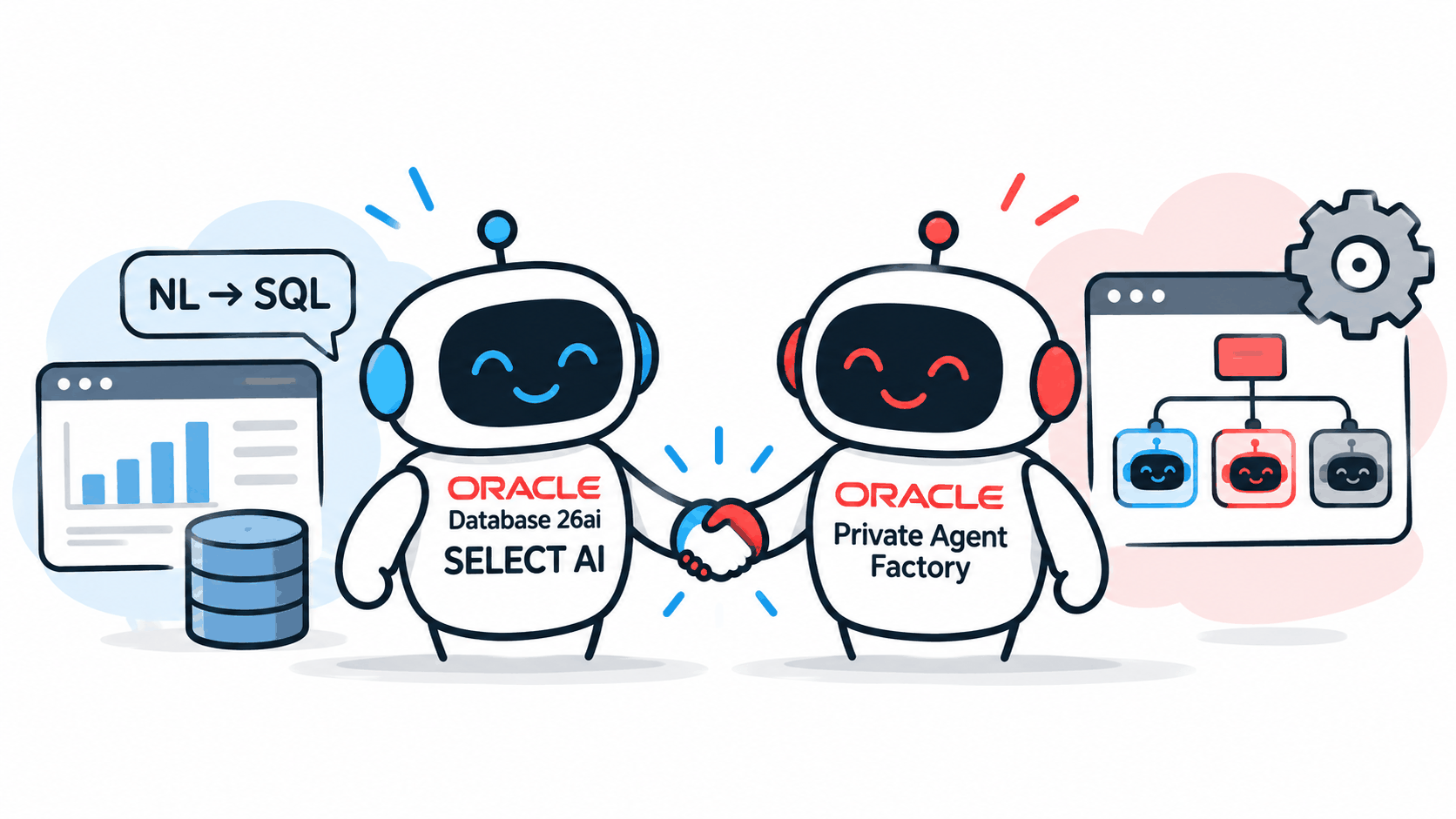
This is the introduction to my blog in eight chapters on using Select AI Agents in Oracle Private Agent Factory. It answers one question: how do Select AI Agent in Autonomous Database 26ai and Oracle Private Agent Factory (OPAF) fit together? I take one sales analyst over my OA Bootcamp sales schema (OABOOTCAMP) and build it six ways in OPAF: plain Select AI, the in-database agent team called natively, the same team built visually without PL/SQL, two flows through the Autonomous Database built-in MCP server, and a native routing flow. Every flow returns the same numbers, because the business definitions live in the database, not in the agent.

When I started, I only wanted to try out how Select AI Agent works with OPAF. It turned into quite an exploratory journey: each experiment opened another way to connect the two, and I ended up with six scenarios. I doubt these are all; there are most likely alternatives I haven't explored yet.

Read more