My presentations @ HROUG 2026

This week I was in Rovinj at the HROUG 2026 conference, where I delivered two sessions. On 15 October I presented AI meets Oracle Analytics: How are we doing and the next question?, and on 16 October No Slides, Just Streams: From live data streams to real-time analytics and chat on Oracle AI Data Platform.
In this post I summarise what each session was about. Both slide decks are available for download at the end.
AI meets Oracle Analytics: How are we doing and the next question?
How are we doing?
I started with the simplest business question there is: How are we doing? For more than 30 years BI and analytics have turned questions like this into models, measures and dashboards, and it works. A dashboard shows performance, trends and targets. The problem starts with the next question: why, where, what should I focus on.
Today AI can answer that next question in many ways: by reading an uploaded spreadsheet, generating Python or SQL, calling tools through connectors and MCP, or retrieving answers from documents. All of these can produce an answer. For enterprise analytics, however, I want AI to go through the governed analytics layer, so the answer uses the same definitions, measures and security as the dashboard. Same question, different path to the answer.
Where Oracle Analytics fits
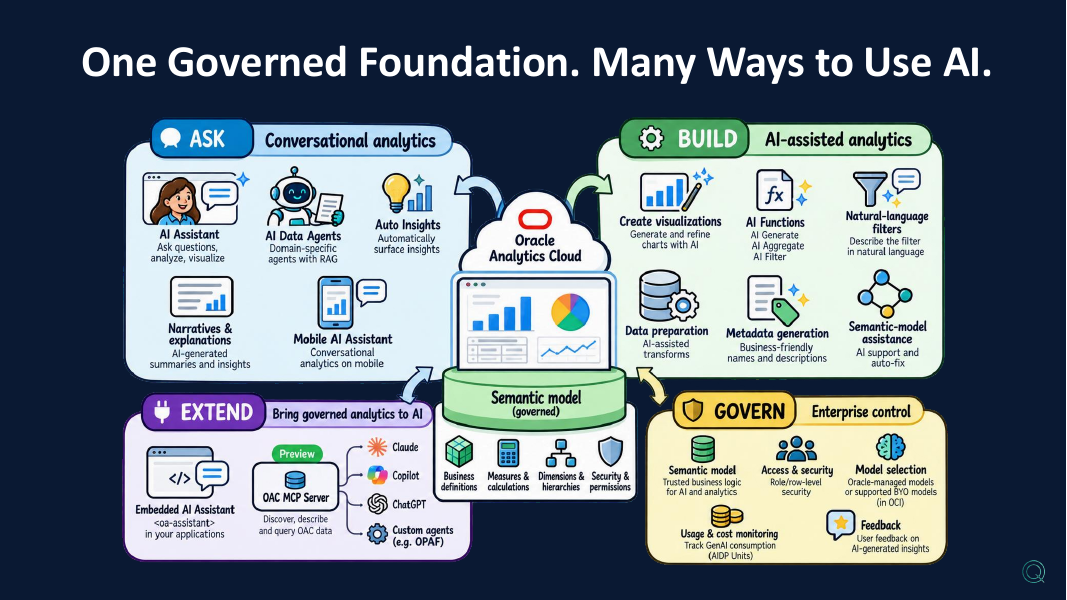
Oracle Analytics offers one governed foundation, the semantic model, with many ways to use AI on top of it: Ask BI, natural-language filters and the Workbook AI Assistant for conversational and AI-assisted analytics, and the OAC MCP Server for bringing governed analytics to external AI clients.
AI Agents in Oracle Analytics
The central part of the session was AI Agents in Oracle Analytics. I split it into three steps:
- Before the agent. Prepare the semantic model (synonyms, AI descriptions), then configure the agent: supplemental instructions (how to interpret questions), a welcome message (how to ask) and knowledge documents (what the data can't tell).
- Using the agent. A conversation that starts with "How is Revenue performing versus Plan?" (on Plan in total), continues with "Which LOB has the largest shortfall?" (Games, well behind Plan) and then shows what happens when a question doesn't name a measure: "Which LOB should I focus on?" returns general advice rather than governed analytics. The lesson: the question has to name what to measure, and the supplemental instructions should map executive language ("focus on", "behind plan") to governed measures.
- After the agent. Attaching the agent to a workbook, so users can ask follow-up questions right where they look at the data.
More on Ask BI, the Workbook AI Assistant and AI Agents is in my Oracle Analytics meets AI series.
Conversational analytics with the OAC MCP Server
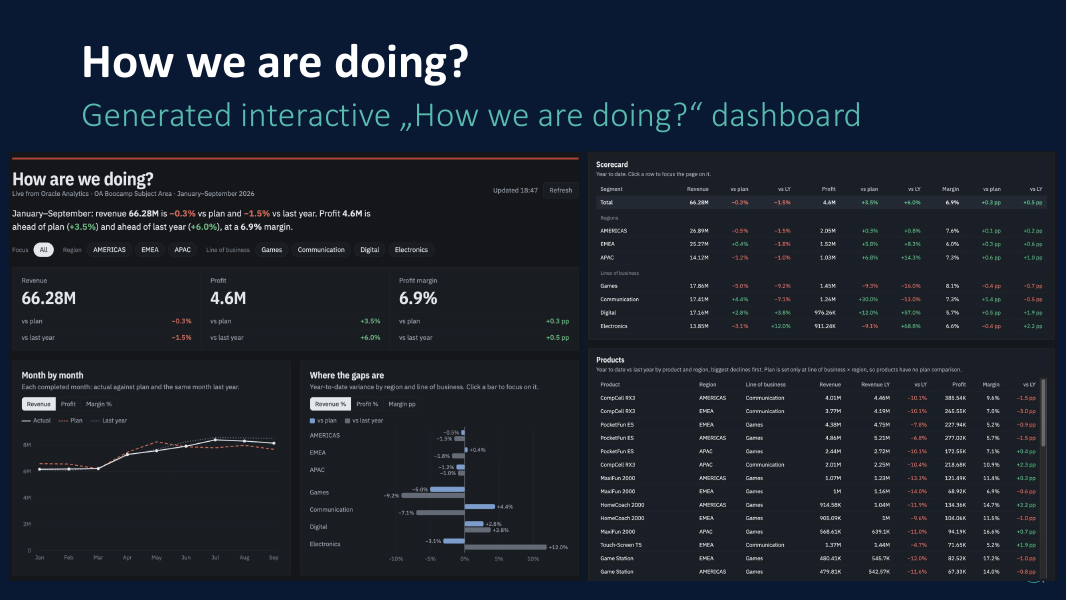
Next, I connected Claude Desktop to Oracle Analytics Cloud through the OAC MCP Server: MCP Connect in the user profile, the MCP Connect tool and an updated claude_desktop_config.json. The agent runs as my OAC user, so data-level security still applies, and it only sees what the semantic layer exposes. I asked it How are we doing?, showed the Logical SQL it generated behind the scenes, and ended with an interactive "How are we doing?" dashboard generated by Claude from governed data.
I've written about OAC and AI, including the MCP Server, in the Unlocking Oracle Analytics Cloud with AI series.
What if I don't have Oracle Analytics Cloud?
Oracle Analytics Server doesn't come with MCP functionality, so I wrote my own MCP server for OAS. It uses the OAS SOAP Web Services and exposes four tools (get_server_info, list_subject_areas, describe_subject_area and execute_logical_sql), with FastMCP turning each Python function into a tool. I showed it with two clients: an Oracle Private Agent Factory (OPAF) custom flow, and Claude Desktop over an SSH tunnel, both answering the same How are we doing? question against OAS.
The setup is described in this post, and the OPAF integration in Oracle Analytics Server MCP & Use cases.
No Slides, Just Streams
The second session was, as the title says, mostly live. A few slides set the scene, and the rest was a working real-time pipeline on Oracle AI Data Platform (AIDP).
The whole story in one picture
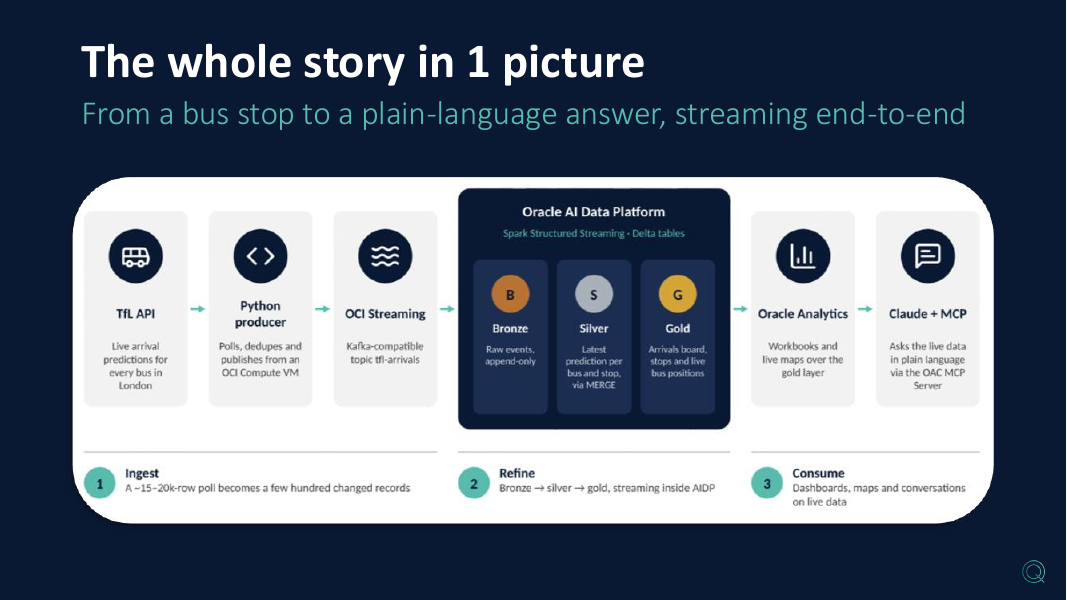
The demo follows London buses from a bus stop to a plain-language answer:
- Ingest. A Python producer polls the Transport for London (TfL) API for live arrival predictions and publishes changed records to OCI Streaming.
- Refine. Spark Structured Streaming in AIDP moves the data through bronze (raw, append-only events), silver (latest prediction per bus and stop, via MERGE) and gold (arrivals board, stops and live bus positions) Delta tables.
- Consume. Oracle Analytics Cloud workbooks and live maps on the gold layer, and Claude asking questions about the live data through the OAC MCP Server.
Why London buses?
The buses aren't really the point. Replace them with delivery trucks, production machines, energy meters, financial transactions or customer interactions, and the problem looks very familiar: something is happening right now, somewhere in the organisation, and the question is how quickly those events can become information people can use. Events happen, data arrives, raw history is preserved, information is refined, business context is added, and people can analyse and act on it.
Every step of the pipeline is described in detail in my AI Data Platform series.
Slides
Download the slides: