AI Data Platform Series: Silver Layer Spark Structure Streaming

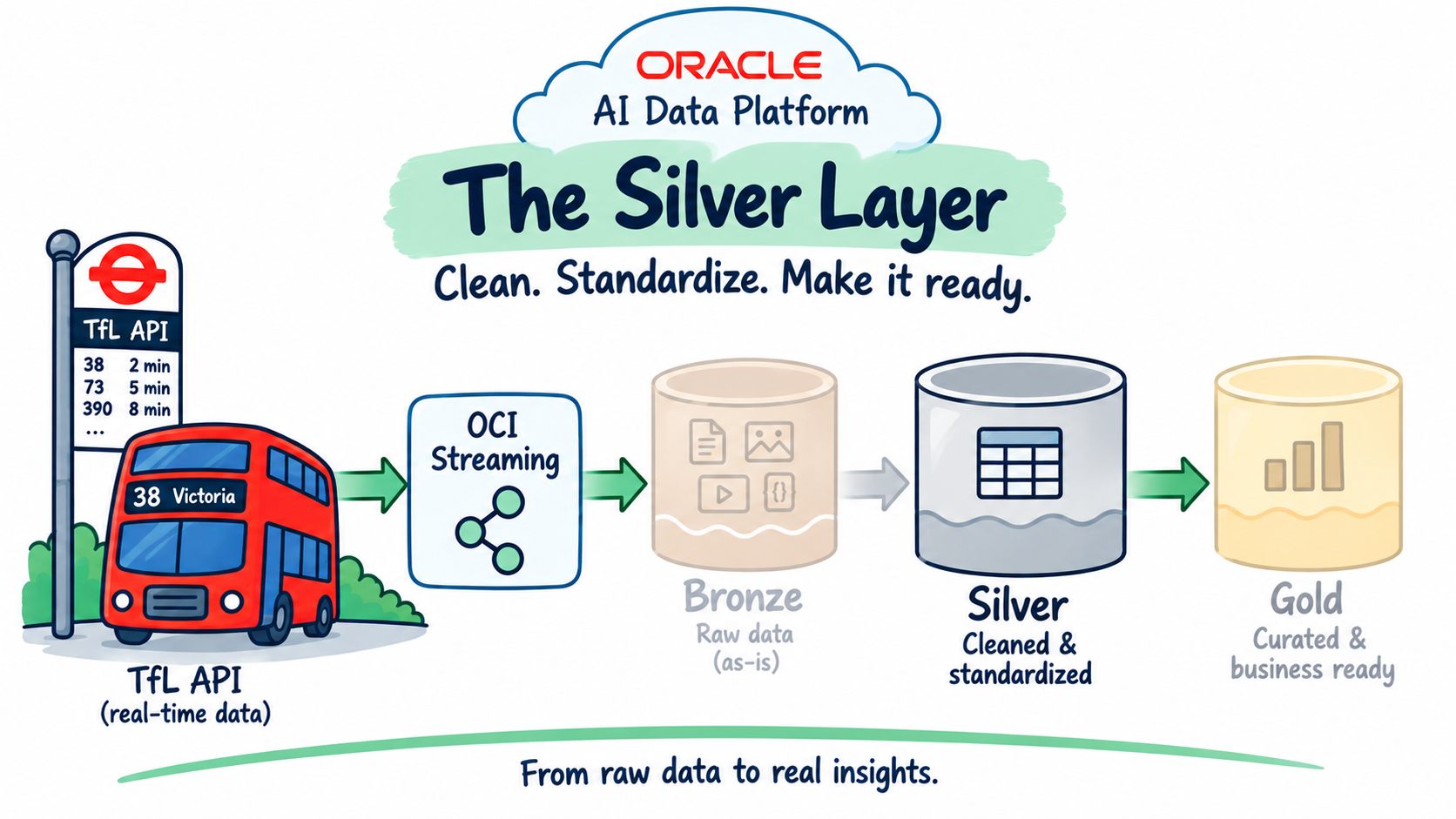
This is the fifth post in the AI Data Platform series, following Just Streams: Real-Time Data Pipelines on OCI (the series intro), Setting Up the AI Data Platform Environment (stage 0), OCI Streaming and the Stream Producer (stage 1), and Bronze Layer: Spark Structured Streaming (stage 2). That last post landed every arrival prediction as-is into an append-only Delta table, tfl.bronze.arrivals_bronze. This post covers stage 3: cleaning that data up, keeping only the latest prediction per vehicle/stop/line/direction, and upserting it into a proper silver table.
In this post I'll walk through:
- Shaping the silver table: a 4-column business key, and two small judgment calls on which bronze fields carry forward.
- Cleaning and typing the bronze stream, then ranking each micro-batch down to one row per key.
- The
MERGE: why Delta needsforeachBatchfor this, and how the upsert condition avoids clobbering fresher rows with stale ones. - OCI Logging, added at the batch level, and the pragmatic call I made on how to authenticate it for a demo like this one.
- Running the pipeline against bronze's live backlog, and confirming the dedup actually held.
Recap: what we have so far
tfl.bronze.arrivals_bronze has been filling up since the last post: every message TfL's Unified API produces, landed as-is, one row per prediction, with a full-fidelity raw_payload column alongside the typed fields. Nothing in bronze is deduplicated or cleaned; the same vehicle approaching the same stop shows up over and over as TfL keeps refreshing its estimate.
That's exactly what a bronze layer is for. Silver is where it gets turned into something more usable: one row per (vehicleId, naptanId, lineId, direction), always reflecting the latest prediction, kept current by an upsert rather than a plain append.
Shaping the silver table
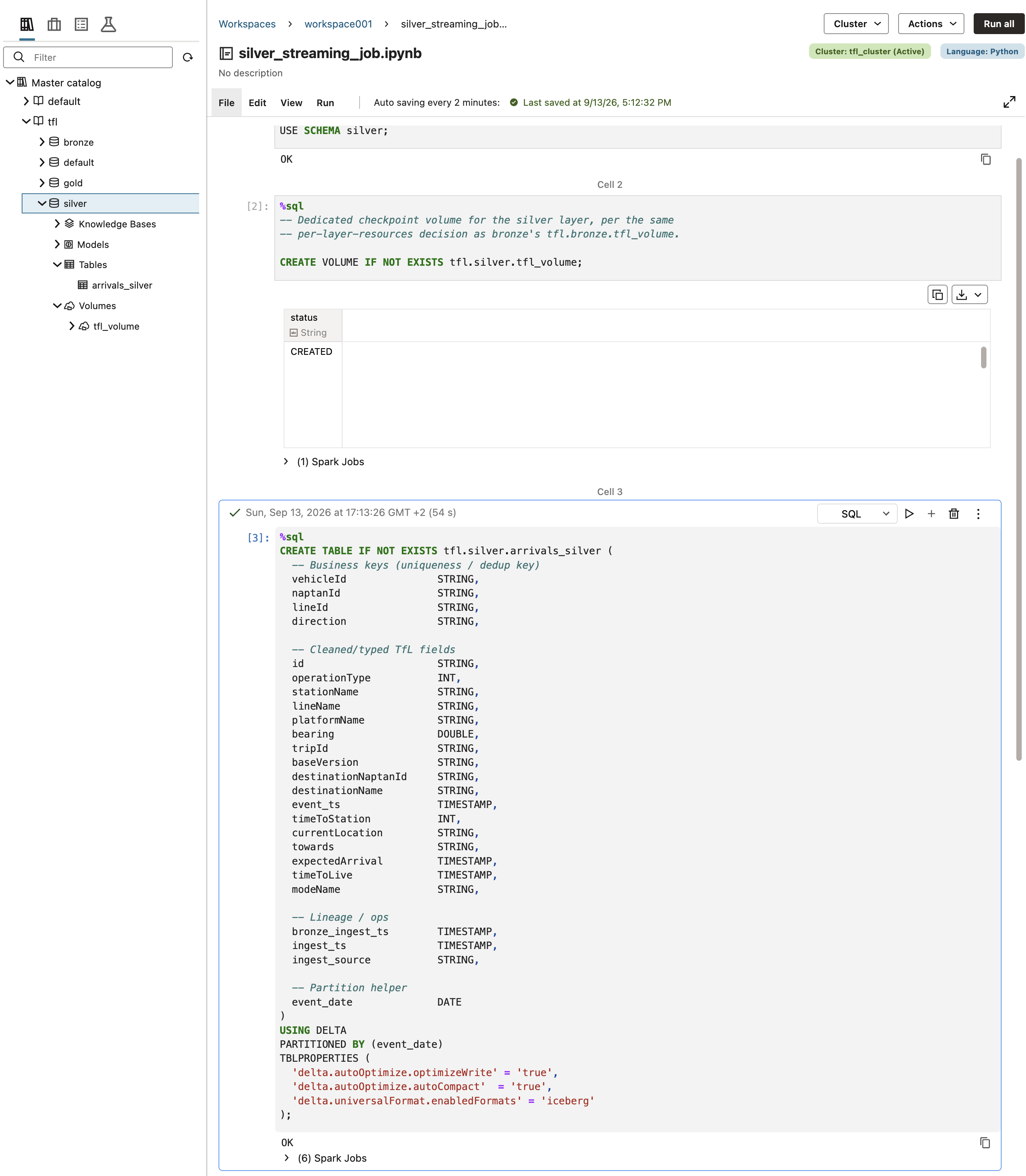
Like bronze, this stage needed no new core OCI resources: it reuses tfl_cluster and the tfl catalog's silver schema, both already in place from stage 0. Two small decisions shaped the table itself before writing any code.
The dedup key is a 4-column composite: vehicleId, naptanId, lineId, direction. A single vehicle can appear multiple times in the same batch if it's serving more than one line or has predictions queued for more than one upcoming stop, so all four columns together are what actually identifies "the current prediction for this vehicle, at this stop, on this line, in this direction."
The other decision was what to carry forward from bronze's two odder fields. timeToLive, the point after which a prediction should be considered stale, is already a clean TIMESTAMP in bronze, so it carries straight through since it's likely useful downstream. timing, TfL's internal diagnostic object with its own source/insert/read/sent/received sub-timestamps, gets dropped at this layer: it's upstream plumbing detail, not cleaned business data. Easy to add back later as a passthrough column if it turns out to matter.
Same per-layer-resources approach as bronze: a dedicated checkpoint volume, tfl.silver.tfl_volume, rather than reusing one from another schema, and catalog-managed storage with no explicit LOCATION.
%sql
USE CATALOG tfl;
USE SCHEMA silver;
%sql
CREATE VOLUME IF NOT EXISTS tfl.silver.tfl_volume;%sql
CREATE TABLE IF NOT EXISTS tfl.silver.arrivals_silver (
-- Business keys (uniqueness / dedup key)
vehicleId STRING,
naptanId STRING,
lineId STRING,
direction STRING,
-- Cleaned/typed TfL fields
id STRING,
operationType INT,
stationName STRING,
lineName STRING,
platformName STRING,
bearing DOUBLE,
tripId STRING,
baseVersion STRING,
destinationNaptanId STRING,
destinationName STRING,
event_ts TIMESTAMP,
timeToStation INT,
currentLocation STRING,
towards STRING,
expectedArrival TIMESTAMP,
timeToLive TIMESTAMP,
modeName STRING,
-- Lineage / ops
bronze_ingest_ts TIMESTAMP,
ingest_ts TIMESTAMP,
ingest_source STRING,
-- Partition helper
event_date DATE
)
USING DELTA
PARTITIONED BY (event_date)
TBLPROPERTIES (
'delta.autoOptimize.optimizeWrite' = 'true',
'delta.autoOptimize.autoCompact' = 'true',
'delta.universalFormat.enabledFormats' = 'iceberg'
);
Reading bronze, cleaning, and de-duplicating
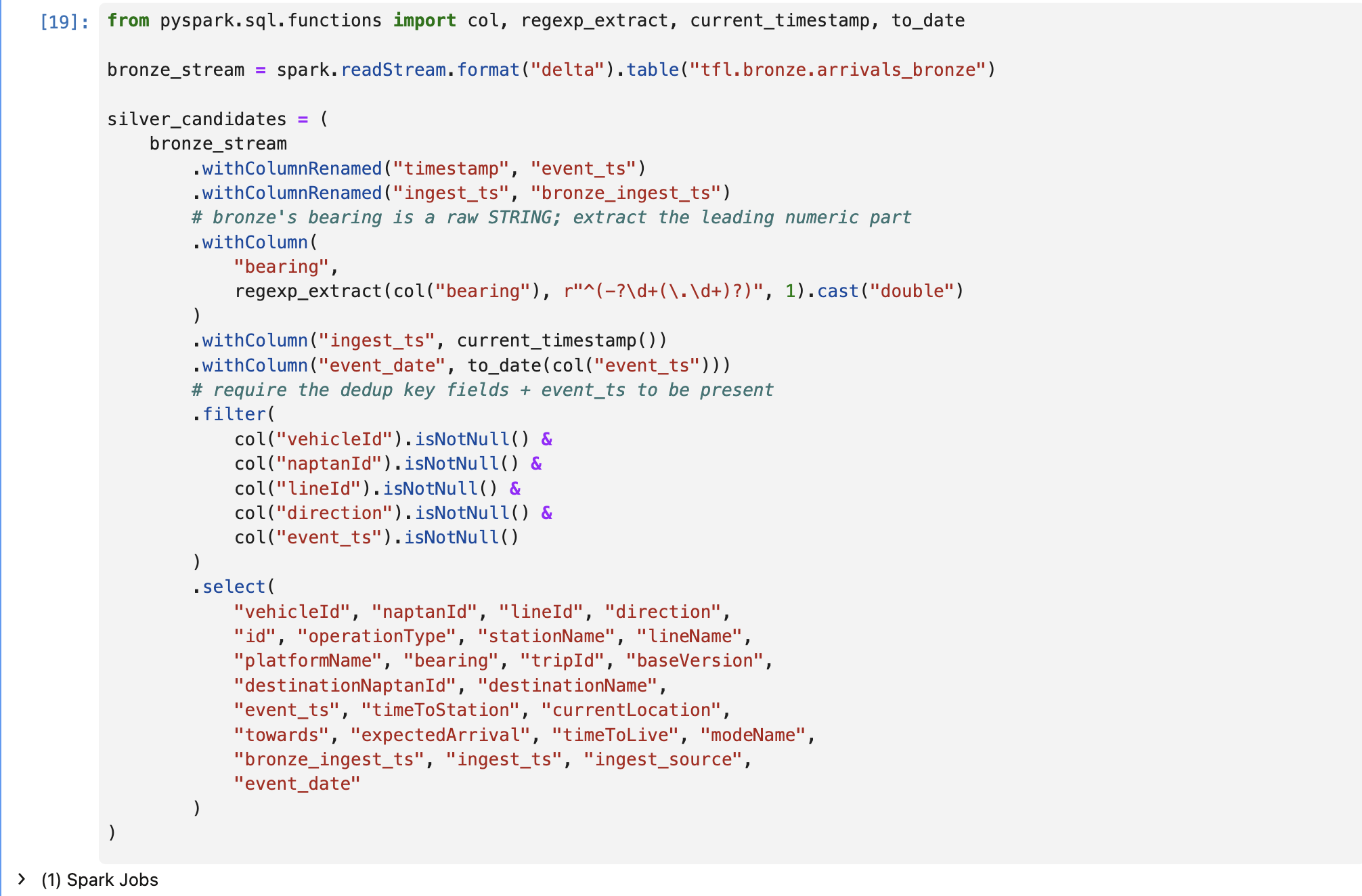
Bronze's timestamp, expectedArrival, and timeToLive columns are already TIMESTAMP-typed there, since bronze casts them on the way in. So this step is mostly renaming and deriving, not re-parsing: timestamp becomes event_ts, bronze's own ingest_ts becomes bronze_ingest_ts to make room for silver's own fresh ingest_ts, and event_date gets derived for partitioning. The one real transform is bearing, which bronze stores as a raw string; a regex extracts the leading numeric part and casts it to DOUBLE.
from pyspark.sql.functions import col, regexp_extract, current_timestamp, to_date

bronze_stream = spark.readStream.format("delta").table("tfl.bronze.arrivals_bronze")

silver_candidates = (
    bronze_stream
        .withColumnRenamed("timestamp", "event_ts")
        .withColumnRenamed("ingest_ts", "bronze_ingest_ts")
        # bronze's bearing is a raw STRING; extract the leading numeric part
        .withColumn(
            "bearing",
            regexp_extract(col("bearing"), r"^(-?\d+(\.\d+)?)", 1).cast("double")
        )
        .withColumn("ingest_ts", current_timestamp())
        .withColumn("event_date", to_date(col("event_ts")))
        # require the dedup key fields + event_ts to be present
        .filter(
            col("vehicleId").isNotNull() &
            col("naptanId").isNotNull() &
            col("lineId").isNotNull() &
            col("direction").isNotNull() &
            col("event_ts").isNotNull()
        )
        .select(
            "vehicleId", "naptanId", "lineId", "direction",
            "id", "operationType", "stationName", "lineName",
            "platformName", "bearing", "tripId", "baseVersion",
            "destinationNaptanId", "destinationName",
            "event_ts", "timeToStation", "currentLocation",
            "towards", "expectedArrival", "timeToLive", "modeName",
            "bronze_ingest_ts", "ingest_ts", "ingest_source",
            "event_date"
        )
)
The foreachBatch upsert
Delta doesn't support a plain streaming MERGE, so a streaming upsert needs foreachBatch: a function that runs once per micro-batch and does an ordinary batch MERGE against whatever rows arrived in that batch. Within each micro-batch, row_number() ranks rows by (vehicleId, naptanId, lineId, direction), ordered by event_ts and then bronze_ingest_ts, both descending. Only the top-ranked row per key survives; that's the "latest per key" logic. The survivors get published as a global temp view, since a %sql-style MERGE statement needs something it can reference by name, then merged into the silver table.
The WHEN MATCHED condition is what keeps this safe against out-of-order batches: a row only overwrites the existing one if its event_ts is genuinely newer, or ties on event_ts and wins on bronze_ingest_ts. Without that, a late-arriving batch with an older prediction could otherwise stomp on a newer one already sitting in the table.
from pyspark.sql import Window
from pyspark.sql.functions import row_number

SILVER_TABLE = "tfl.silver.arrivals_silver"
KEY_COLS = ["vehicleId", "naptanId", "lineId", "direction"]


def upsert_latest_per_key(batch_df, batch_id: int):
    try:
        if batch_df.rdd.isEmpty():
            log_to_oci(f"batch_id={batch_id} empty_batch=true")
            return

        w = Window.partitionBy(*KEY_COLS).orderBy(
            col("event_ts").desc(),
            col("bronze_ingest_ts").desc()
        )

        latest_in_batch = (
            batch_df
                .withColumn("rn", row_number().over(w))
                .filter(col("rn") == 1)
                .drop("rn")
        )

        latest_in_batch.createOrReplaceGlobalTempView("silver_updates")

        merge_sql = f"""
        MERGE INTO {SILVER_TABLE} AS s
        USING global_temp.silver_updates AS u
        ON  s.vehicleId = u.vehicleId
        AND s.naptanId  = u.naptanId
        AND s.lineId    = u.lineId
        AND s.direction = u.direction
        WHEN MATCHED AND (
            u.event_ts > s.event_ts OR
            (u.event_ts = s.event_ts AND u.bronze_ingest_ts >= s.bronze_ingest_ts)
        ) THEN UPDATE SET *
        WHEN NOT MATCHED THEN INSERT *
        """

        spark.sql(merge_sql)
        log_to_oci(f"batch_id={batch_id} action=merge rows={latest_in_batch.count()}")

    except Exception as e:
        log_to_oci(f"batch_id={batch_id} action=error error={str(e)[:500]}")
        raise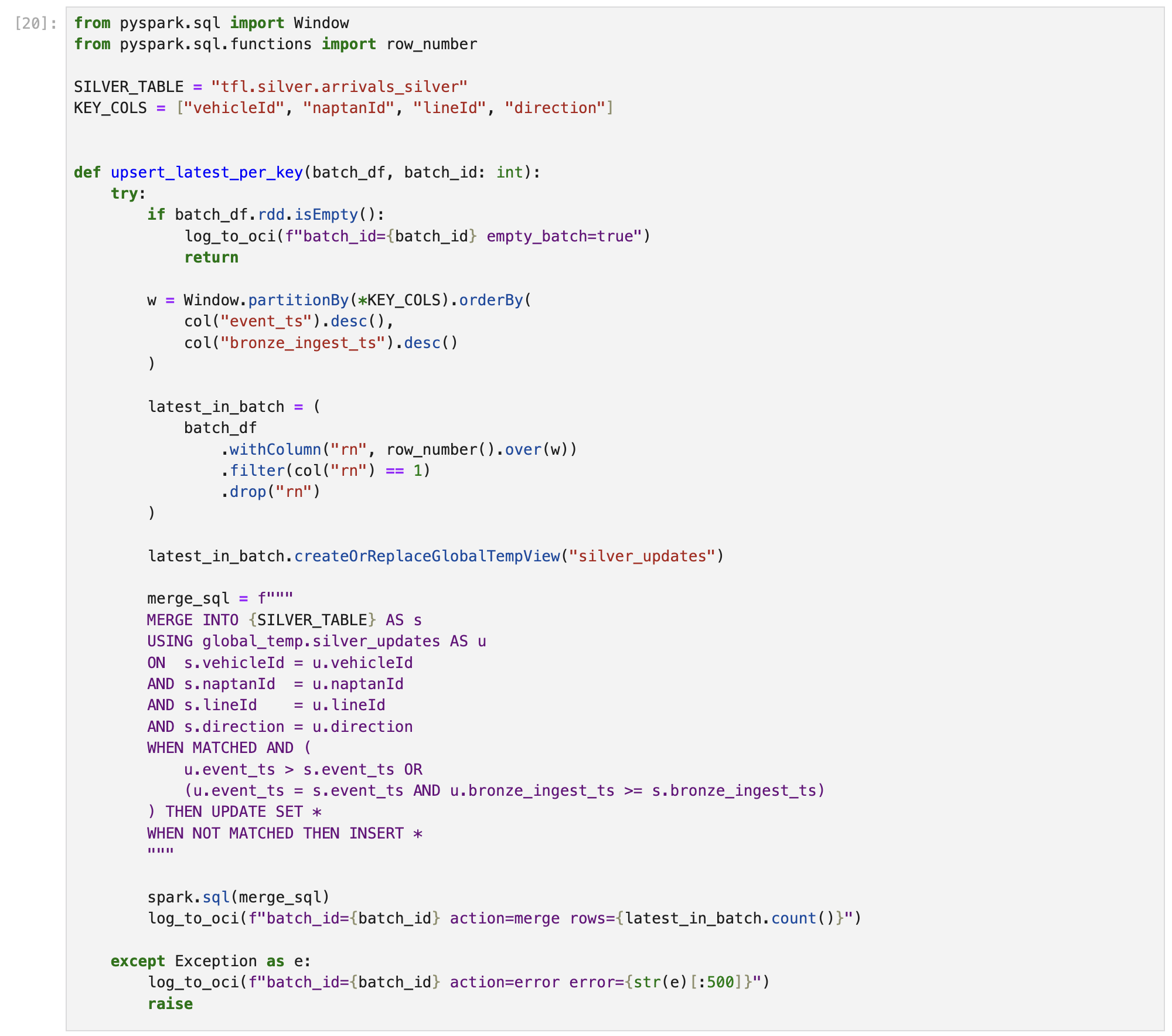
OCI Logging, briefly
Each foreachBatch call also writes a line to OCI Logging (log_to_oci(), called above): batch id, row count, or the error if the MERGE failed. AIDP's notebooks don't expose a resource-principal token or standard OCI instance-metadata access, so neither of the two "automatic identity" mechanisms OCI normally offers worked here, and the Credential Store's Service account credential type can't be created from a currently logged-in user's own identity either. For this demo, the pragmatic fix was my own OCI API signing key, uploaded once into the workspace's own file storage and referenced by path. It ties the pipeline's logging permission to my personal identity rather than a proper scoped service account, which would be the right call for anything beyond a demo like this one, but it's more setup than this feature needed here.
Running the stream, verifying, and stopping it
Same manual, on-demand model as bronze: run the write cell when data should flow, stop it when done. The trigger interval is 5 seconds here rather than bronze's 2, since every micro-batch now also runs a MERGE, a heavier operation than a plain append.
CHECKPOINT_PATH = "/Volumes/tfl/silver/tfl_volume/checkpoints/arrivals-silver"
TRIGGER_SEC = 5

query = (
    silver_candidates.writeStream
        .foreachBatch(upsert_latest_per_key)
        .option("checkpointLocation", CHECKPOINT_PATH)
        .trigger(processingTime=f"{TRIGGER_SEC} seconds")
        .start()
)

query.awaitTermination()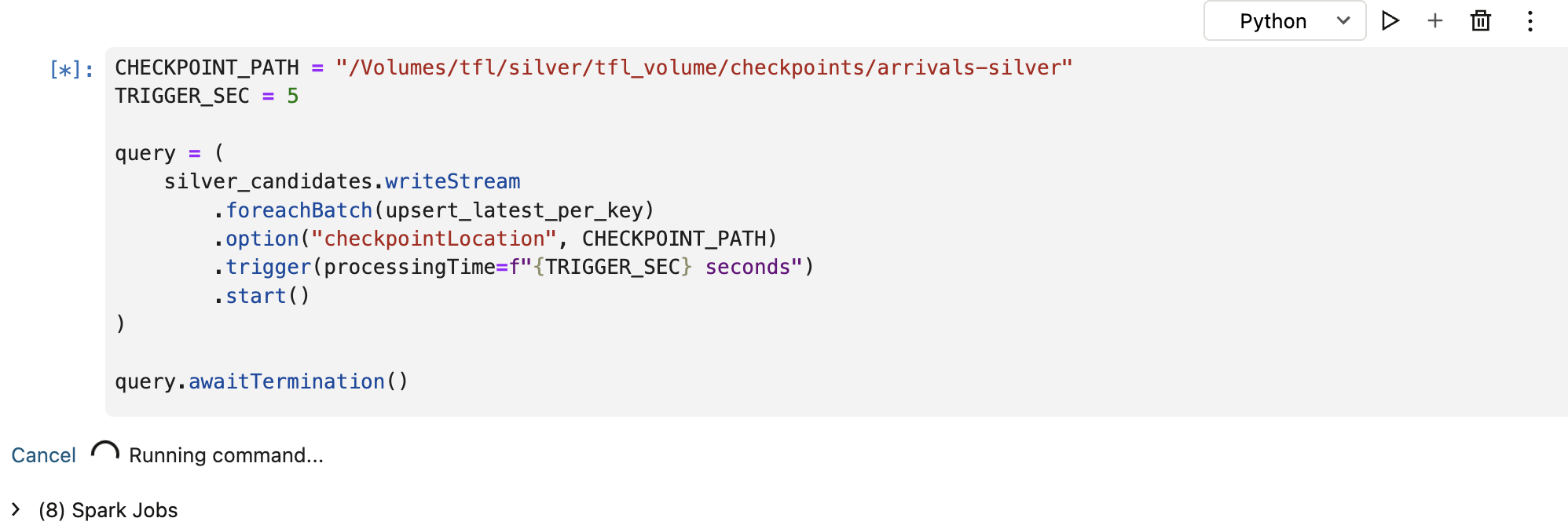
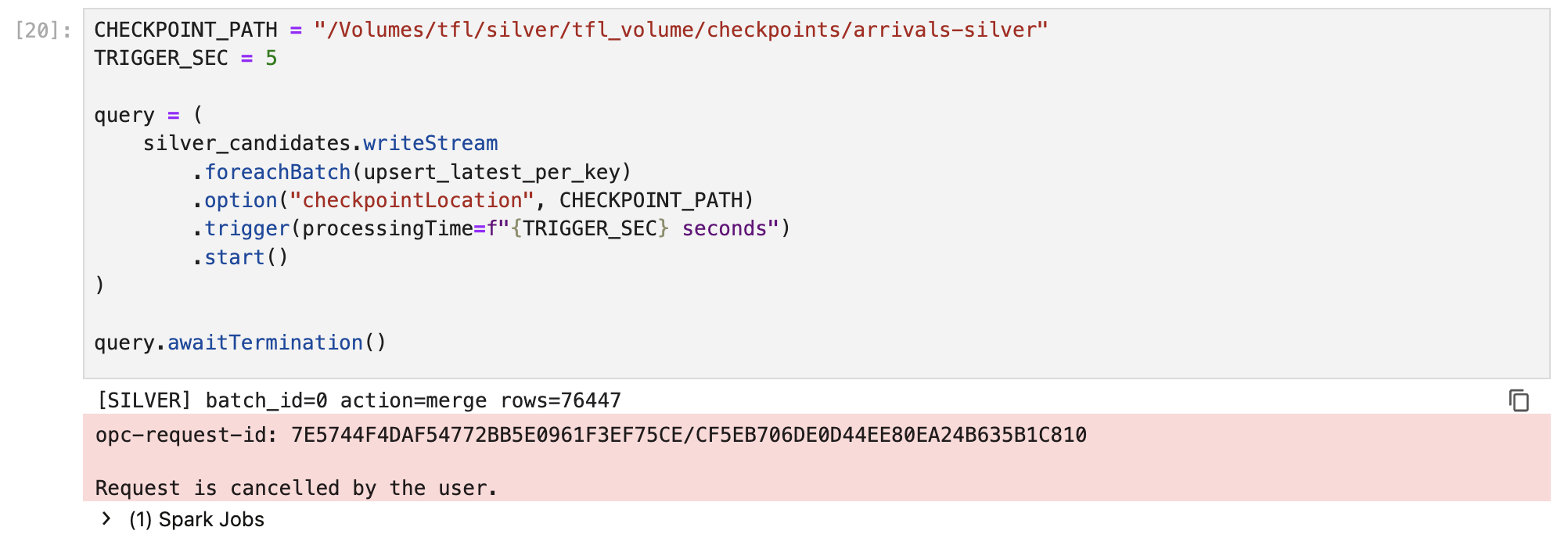
With bronze's stream running to keep data flowing, silver's very first micro-batch picked up bronze's entire existing backlog at once: 76,447 rows, merged in a single batch. Stopping the stream is the same two-step dance as bronze: cancel the blocked write cell (its own Cancel option, the only interrupt control this notebook UI has), then run query.stop() in a separate cell to actually release the checkpoint.
query.stop()print(query.isActive) # expect: FalseVerifying it worked meant two things. First, the ordinary checks:
%sql
SELECT count(*) AS row_count, max(ingest_ts) AS last_ingest
FROM tfl.silver.arrivals_silver;
%sql
SELECT vehicleId, naptanId, lineId, direction, stationName, event_ts, expectedArrival, ingest_ts
FROM tfl.silver.arrivals_silver
ORDER BY ingest_ts DESC
LIMIT 20;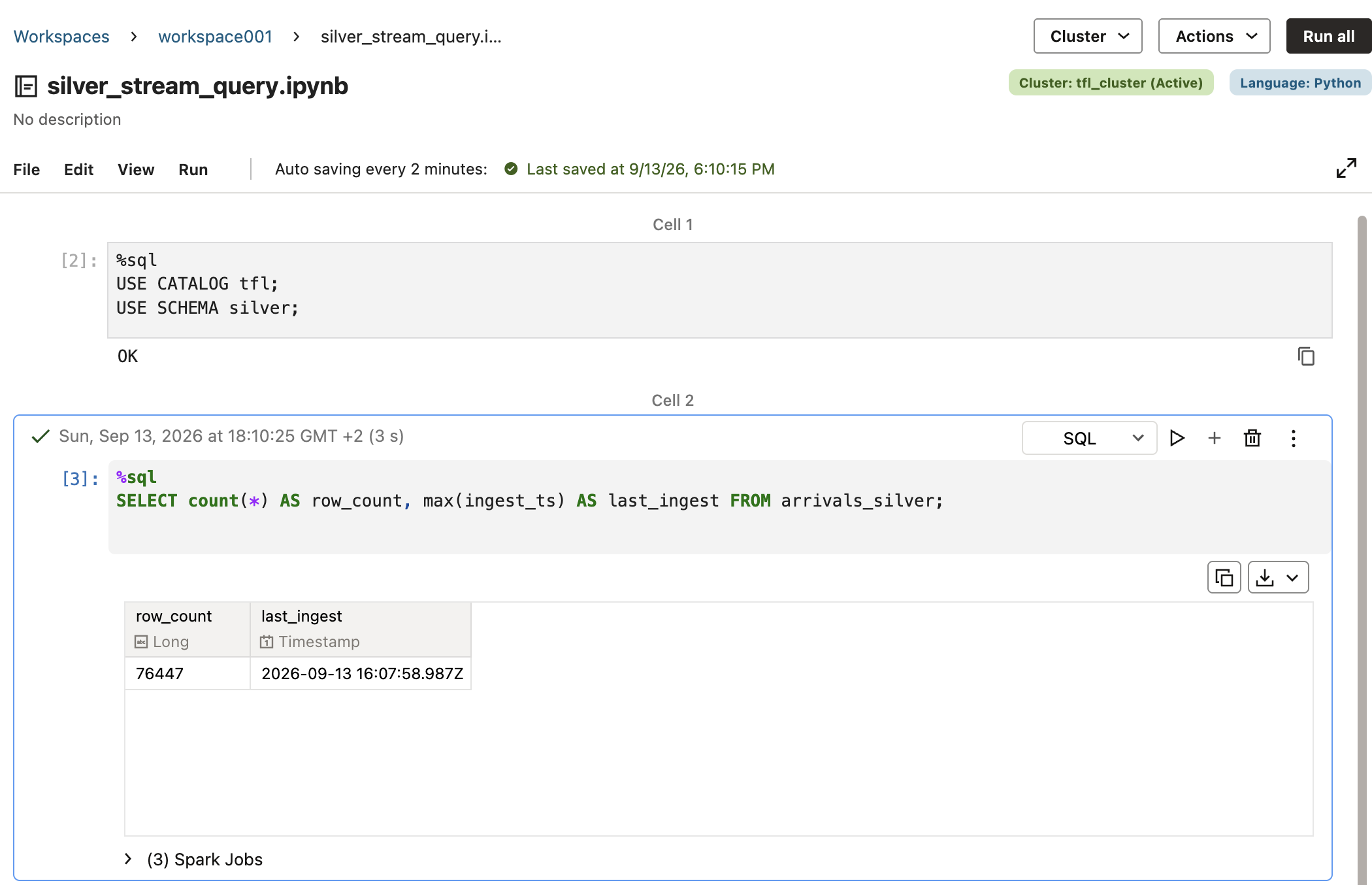
Second, and more specific to this layer: a dedup sanity check, run from the second observational notebook attached to the same cluster while the main job runs.
%sql
SELECT vehicleId, naptanId, lineId, direction, count(*) AS cnt
FROM tfl.silver.arrivals_silver
GROUP BY vehicleId, naptanId, lineId, direction
HAVING count(*) > 1;
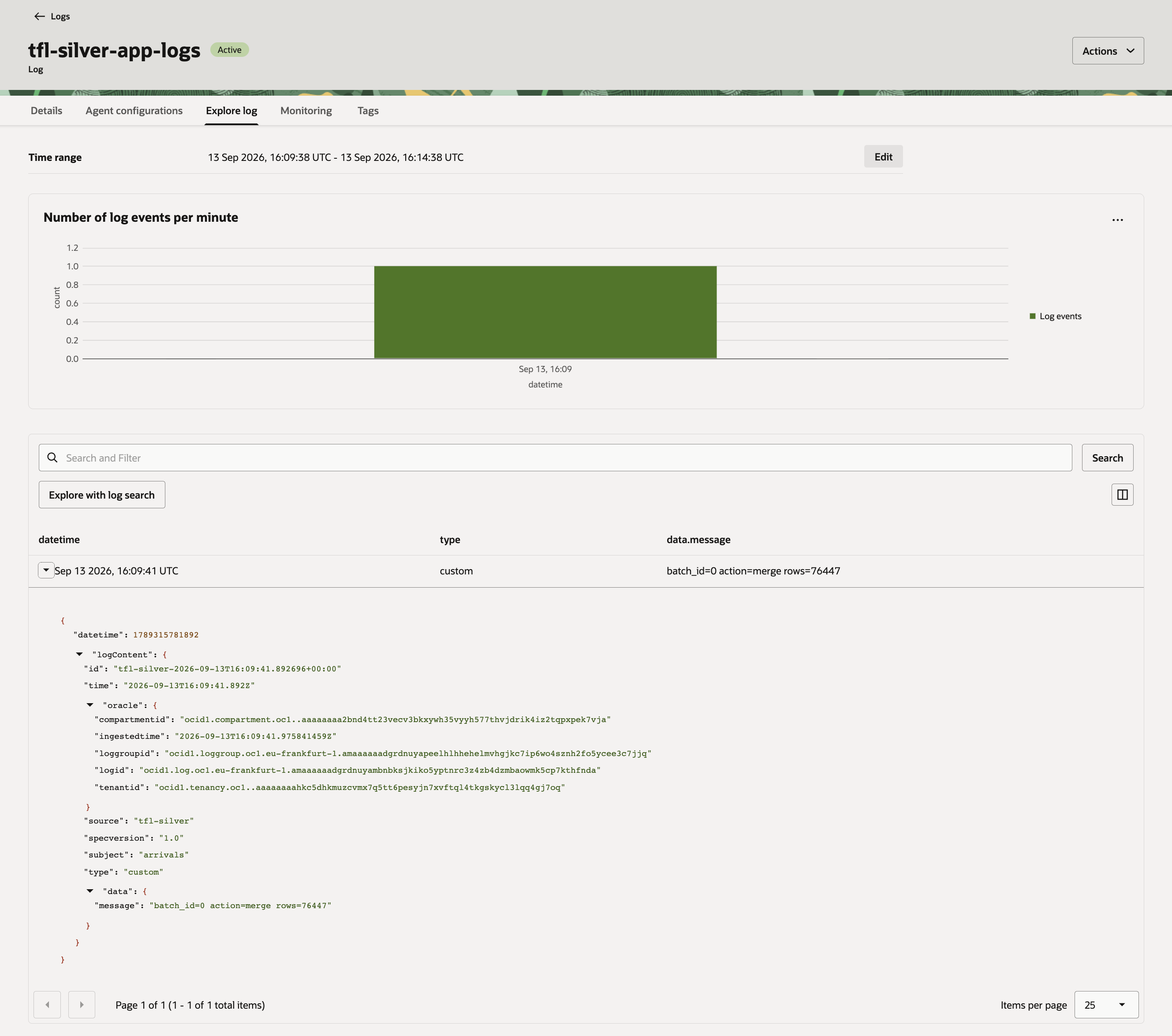
That query came back empty, confirming the latest-per-key logic held: every key in the table has exactly one row. OCI Logging held up too; the batch_id=0 action=merge rows=76447 line showed up as a real structured entry in the Log Explorer, not just a local print.
What's next
With tfl.silver.arrivals_silver staying current as a clean, deduplicated table, the next post moves to the gold layer: aggregating this into something Oracle Analytics Cloud can query directly, and starting to bring in position data for mapping.
Related: Just Streams: Real-Time Data Pipelines on OCI (series intro), Setting Up the AI Data Platform Environment, OCI Streaming and the Stream Producer, Bronze Layer: Spark Structured Streaming