My Presentation @ Oracle Technology Roundtable, August 2026

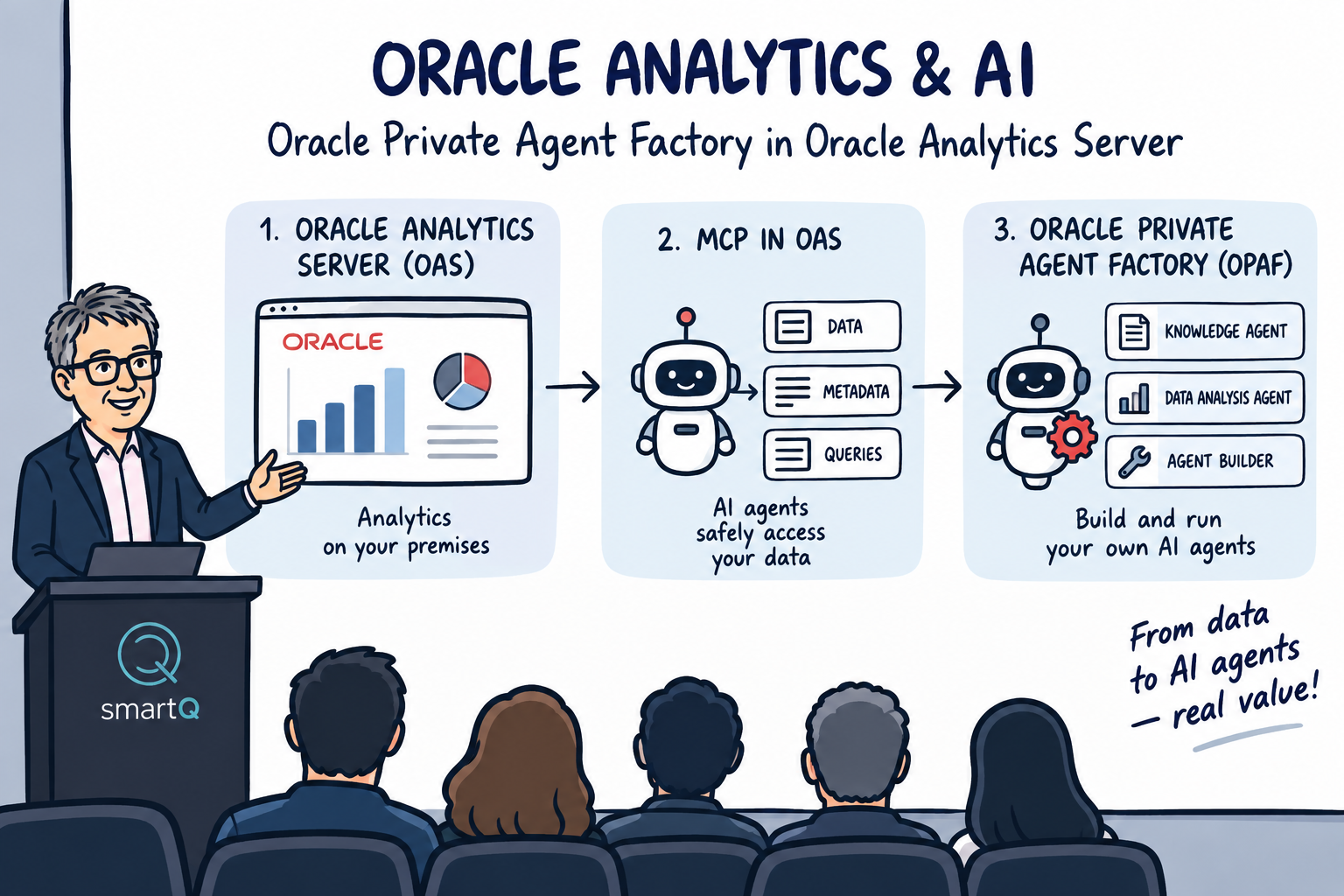
On 26 August 2026 in Ljubljana, I took part in the Oracle Technology Roundtable, where I presented together with my SmartQ colleagues Mojca Gros and Grega Dvoršak.
For the event, we prepared a joint presentation titled “Oracle Analytics & AI”, with the subtitle “Oracle Private Agent Factory in Oracle Analytics Server.” The session brought together three closely related topics: the latest Oracle Analytics Server platform, the use of Model Context Protocol with OAS, and Oracle AI Database Private Agent Factory.
Download the presentation (PDF)
Oracle Analytics & AI
Our presentation was divided into three main parts.
1. Oracle Analytics Server (OAS)
The first part focused on Oracle Analytics Server, the on-premises counterpart of Oracle Analytics Cloud. We looked at Oracle Analytics Server 2026 and discussed the role of business intelligence and data warehousing as more than just an IT project: BI provides the visible analytical layer, while the data warehouse provides the trusted data foundation needed for consistent KPIs, faster analysis and better-informed decisions.
This part also included a demonstration of Oracle Analytics Server 2026.
2. Model Context Protocol (MCP) in OAS
The second part moved from traditional analytics toward AI-assisted analytics and introduced the Model Context Protocol (MCP).
We explained how MCP provides a standard way for AI agents and large language models to connect to external tools, data and services. In our OAS example, we showed an MCP Server Bridge for Oracle Analytics Server, allowing AI clients such as Claude, Codex or other LLM-based applications to discover analytical content, inspect metadata and execute Logical SQL against OAS.
Because this capability was not available natively in OAS, we demonstrated an MCP bridge that connected an AI client with Oracle Analytics Server through its services and semantic layer. The session included a live demonstration of querying OAS data conversationally through the MCP server.
3. Oracle AI Database Private Agent Factory (OPAF)
My part of the presentation focused on Oracle AI Database Private Agent Factory (OPAF) and on how Oracle was bringing AI-agent development closer to enterprise data and applications.
I started by introducing OPAF as a no-code platform for developing, testing, managing and running AI agents. We also looked at its deployment model: because of its container-based architecture, OPAF could be deployed in the cloud, for example in OCI, or locally inside an organization's own environment, including isolated or air-gapped environments. OPAF was provided as an extension around Oracle Database and required Oracle Database 26ai for capabilities such as Vector Search.
A Closer Look at OPAF
After the introduction, I walked through the main building blocks of the OPAF architecture.
At the center was the Agent Factory container, which provided the no-code user interface, pre-built agents, SQLcl MCP support, Open Agent Specification, SELECT AI, the Visual Agent Builder and the agent runtime. The platform could work with different storage and data services and connect to either local AI services or cloud-based Generative AI services for LLM and embedding capabilities. Oracle Database 26ai provided the Agent Factory schema and vector store underneath the solution.
I also showed the two main ways in which OPAF could be obtained and deployed: through Oracle Marketplace for deployment in OCI, or through Oracle Software Delivery Cloud for a local installation.
Knowledge Agent
The first practical use case was the Knowledge Agent.
I showed how a Knowledge Agent could combine an LLM with enterprise information to provide contextual answers based on approved knowledge sources. The underlying process followed the familiar RAG pattern: documents were loaded and transformed, embeddings were generated and stored in a vector database, and similarity search was used to retrieve relevant information before the LLM generated its response.
The important point was that the agent did not have to rely only on the general knowledge of the LLM. It could retrieve information from enterprise knowledge bases, documents and other sources, producing responses that were grounded in the organization's own content and traceable back to those sources.
Data Analysis Agent
The second example was the pre-built Data Analysis Agent.
This agent was designed to interact directly with databases, understand schema structures and use LLM capabilities to generate semantic insights. We looked at how it could analyze the available tables and views, enrich a user's question, generate SQL, execute it against an Oracle Database and automatically explore the resulting data.
The example also demonstrated capabilities such as variation analysis, LLM-supported explanations and automatic generation of visualizations. It illustrated a different kind of AI interaction: instead of retrieving knowledge from documents, the agent could reason over structured enterprise data and help users explore it conversationally.
Building Custom Agents with Agent Builder
Finally, I moved from the pre-built agents to Agent Builder, OPAF's visual environment for creating custom agents and workflows.
I showed how workflows could combine different components, including LLMs, agents, MCP servers, REST APIs, conversational memory, chat and text inputs, file uploads, CSV files, SQL queries and different output nodes. OPAF also supported multiple LLM options, including local and cloud-based providers.
The visual approach made it possible to go beyond a single chatbot and orchestrate more complex, multi-step AI processes by connecting specialized agents and tools into a workflow. The platform was also extensible, with the possibility of creating additional custom nodes for Agent Builder.
I concluded my part of the session with a live OPAF demonstration, showing the platform and a more complex agent workflow built visually in Agent Builder.
From Analytics to AI Agents
Taken together, the three parts of our presentation showed a progression from established enterprise analytics toward agent-based interaction with enterprise information.
We started with Oracle Analytics Server as the governed analytics platform, extended it through MCP so that AI clients could discover and query analytical data, and then moved to OPAF, where AI agents could work with knowledge, databases, tools and custom workflows in a controlled enterprise environment.
It was a practical look at how Oracle Analytics, open integration standards such as MCP, and Oracle's emerging agent platform could come together to create a new way of interacting with enterprise data.